How Does Cricket Scoring Work? This Ultimate Guide Will Help You Understand Everything
Published: 31 Jan 2025
If you are new to cricket, the scoreboard can look confusing at first. You see numbers like 148/5, 17.3 overs, or RR 8.45, and it can feel like the game is speaking another language.
The good news is that cricket scoring is not as hard as it looks.
Once you understand runs, wickets, overs, extras, and boundaries, the whole thing starts to make sense. In fact, after a little practice, you can look at a score and understand what is happening in seconds.
So, how does cricket scoring work? Let’s break it down in a simple way.
What Does a Cricket Score Mean?
A cricket score usually shows two main things:
- total runs scored
- wickets lost
For example:
120/4
This means:
- The batting team has scored 120 runs
- They have lost 4 wickets
That is the basic idea behind most cricket scores.
You may also see something like:
120/4 in 15 overs
That means:
- the team made 120 runs
- lost 4 wickets
- and faced 15 overs
So if you have ever wondered, what does a cricket score mean, that is the simplest answer. It tells you how many runs a team has and how many batters are already out.
How Are Runs Scored in Cricket?
This is the next big question. How are runs scored in cricket?
A batting team scores runs in a few main ways:
- by running between the wickets
- by hitting boundaries
- through extras
- sometimes through overthrows
All of these add to the team score.
Let’s go one by one.
Running Between the Wickets
The most basic way to score in cricket is by running.
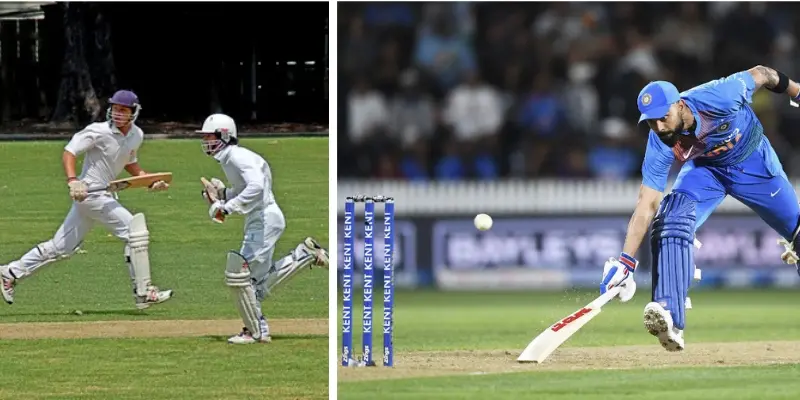
After the batter hits the ball, the two batters can run to the other end of the pitch. If they both make it safely, that is 1 run.
If they run back again, that becomes 2 runs.
If they keep going and complete three runs, then it is 3 runs.
This is the most common type of scoring in cricket. A lot of innings are built on singles and doubles, not just boundaries.
So if you wonder, how does cricket scoring work for beginners, this is a great place to start. Batter hits the ball. Batters run. Each completed run adds to the score.
How Boundaries Work
Cricket also has boundaries, and these are easy to understand.
Four runs
If the batter hits the ball and it reaches the boundary rope after touching the ground, the team gets 4 runs.
Six runs
If the batter hits the ball over the boundary without it bouncing first, the team gets 6 runs.
This is why big hitters are so exciting to watch. One clean shot can add a lot to the score very quickly.
If you were wondering how are boundaries counted in cricket, that is the rule:
- ball reaches boundary after bouncing = 4
- ball clears boundary on the full = 6
Do Batters Get Runs from Overthrows?
This is one of those questions beginners do not always think about right away, but it matters.
Yes, extra runs can come from overthrows.
An overthrow happens when a fielder throws the ball badly and it goes past the stumps or another fielder. The batters can then run more.
Those runs are added to the team score. Depending on the situation, they may also be added to the batter’s score.
So if you get confused about do batsmen get runs from overthrows, the short answer is usually yes for completed runs, though the exact scoring can depend on how the play happened.
What Is a Dot Ball in Cricket?
A dot ball is a legal delivery where no run is scored.
It is called a dot ball because scorers often record it as a dot in the scorebook.
So, what is a dot ball in cricket?
It means:
- the batter did not score
- no extras were given
- the team total did not change
Dot balls are very important, especially in short formats like T20 and ODI cricket. They create pressure. A team can score freely for a few balls, then suddenly, a few dot balls slow everything down.
That is why people often talk about:
- cricket dot ball
- dots in cricket
- building pressure with dot balls
Even though a dot ball adds no runs, it still affects the game a lot.
How Are Extras Counted in Cricket?
Extras are runs that do not come from the batter’s bat in the usual way. They still count toward the team score, though.
This is a key part of understanding the cricket scoring system.
The four main extras are:
- wides
- no-balls
- byes
- leg byes
Let’s look at each one.
What Is a Wide?
A wide is given when the bowler sends the ball too far from the batter for it to be played fairly.
The batting team gets 1 extra run.
In many cases, the ball also has to be bowled again because it does not count as a legal delivery.
So if you want to explain cricket scoring clearly, wides are one of the first extras to mention.
What Is a No-Ball?
A no-ball is an illegal delivery.
This can happen for different reasons, such as:
- overstepping the crease
- bowling a dangerous ball
- breaking certain bowling rules
The batting team gets 1 extra run for a no-ball.
In limited-overs cricket, the next ball may also become a free hit, depending on the kind of no-ball.
What Are Byes?
Byes happen when:
- The ball goes past the batter
- It does not hit the bat
- It does not hit the batter’s body
- and the batters run
Those runs count as extras.
What Are Leg Byes?
Leg byes happen when:
- The ball hits the batter’s body
- not the bat
- and the batters run
These also count as extras, not as runs for the batter.
So if someone asks you, how are extras counted in cricket, the answer will be that all of these are added to the team total, but not all are credited to the batter.
What Is the Difference Between a No-Ball and a Wide?
This is a very common beginner question.
A wide is about the ball being too far away to be played fairly.
A no-ball is about the delivery being illegal for some reason.
Both give the batting side 1 extra run, but they are not the same thing.
This small difference matters a lot when you are learning how cricket scoring works.
How Do You Read a Cricket Scoreboard?
Now let’s get into one of the biggest beginner questions:
How do you read a cricket scoreboard?
A scoreboard usually shows:
- team runs
- wickets
- overs
- batter scores
- bowler figures
- run rate
- sometimes target and required run rate
Here is a simple example:
India 168/4 in 18.2 overs
This means:
- India scored 168 runs
- lost 4 wickets
- and has faced 18 overs and 2 balls
That last part is important. In cricket, 18.2 overs does not mean 18.2 in a decimal sense. It means:
- 18 full overs
- plus 2 more balls
Since 1 over = 6 legal balls, the scoreboard uses that format instead of decimals.
What Do Overs Mean in Cricket Scoring?
An over is a set of 6 legal balls bowled by one bowler.
If the bowler delivers:
- 6 legal balls = 1 over
- 12 legal balls = 2 overs
- 18 legal balls = 3 overs
If the scoreboard shows 15.3 overs, that means:
- 15 complete overs
- Plus 3 balls of the next over
This is one of the biggest reasons beginners get confused. The number after the dot is not tenths. It is balls.
So if you were wondering, what do overs mean in cricket scoring, that is the answer.
What Do Wickets Mean in a Cricket Score?
When you see a score like 120/4, the second number tells you how many wickets have fallen.
In simple words, it means how many batters are already out.
So:
- 120/0 means no batter is out yet
- 120/4 means four batters are out
- 120/9 means nine batters are out
This matters because a team can only lose a certain number of wickets before the innings ends.
So if you were asking, what do wickets mean in a cricket score, they show how many outs the batting side has lost.
What Does RR Mean on a Cricket Scorecard?
RR means Run Rate.
Run rate tells you how quickly a team is scoring.
The formula is simple:
Run Rate = Total Runs ÷ Overs Faced
For example:
- 100 runs in 10 overs = run rate of 10.00
- 150 runs in 20 overs = run rate of 7.50
Run rate helps you understand whether a team is scoring fast or slow.
In a chase, you may also see Required Run Rate, which shows how quickly the batting team now needs to score to reach the target.
So, if you were asking, what does RR mean on a cricket scorecard, it means run rate.
How Is a Batter’s Score Calculated?
A batter’s score includes:
- runs from singles
- doubles
- triples
- fours
- sixes
It does not include:
- wides
- byes
- leg byes
- no-ball extras, unless runs also came from the bat
For example:
- if a batter hits a four, that is 4 runs to the batter and team
- if the bowler bowls a wide, that is 1 run to the team, but not the batter
- if the batter misses and they run a bye, that adds to the team, not the batter
So if you want to know how is a batsman’s score calculated, it is based only on runs credited to that batter.
How Is Team Score Calculated in Cricket?
The team score is the total of:
- All batter runs
- All extras
So the scoreboard combines everything:
- singles
- boundaries
- overthrows
- wides
- no-balls
- byes
- leg byes
That is why team totals are always bigger than just one player’s contribution.
This is the heart of the cricket scoring system.
What Does 120/4 Mean in Cricket?
Let’s answer this directly because many people search it exactly this way.
120/4 means:
- The team has scored 120 runs
- The team has lost 4 wickets
That is it.
If overs are shown too, it becomes even clearer.
For example:
120/4 in 15 overs
means the batting team has 120 runs, 4 players out, and has faced 15 overs.
This is one of the easiest ways to make cricket score explained content useful for beginners.
How Is Scoring Different in Test, ODI, and T20 Cricket?
The basic scoring rules stay the same in all formats:
- Runs are runs
- Wickets are wickets
- Extras still count
- Boundaries still count the same way
But the match format changes the scoring style.
Test cricket
- Played over much longer periods (5-day game maximum)
- Teams build innings more patiently
- Dot balls matter, but the pressure is different
- Totals can become very large
ODI cricket
- Each team gets 50 overs
- Batting is more aggressive than in Tests
- Teams balance caution and attack
T20 cricket
- Each team gets 20 overs
- Scoring is much faster
- Boundaries and strike rate matter a lot
- Dot balls can hurt badly
So if you were wondering, how is scoring different in Test, ODI, and T20 cricket, the rules are the same, but the pace and strategy are very different.
What Is a Good Score in Cricket?
This depends on the format, pitch, conditions, and opposition.
Still, a rough beginner idea looks like this:
In T20
- 150 can be competitive
- 180 is often strong
- 200 is usually a very big score
In ODI
- 250 can be decent
- 300 is often strong
- 350 is a major total
In Test cricket
There is no simple answer because the innings can last much longer. Context matters much more.
So if you ask, what is a good score in cricket, the answer depends on the format.
How Do Cricket Scores Work for Beginners? A Simple Example
Let’s make this very easy.
Imagine a team scores:
150/5 in 20 overs
This means:
- the team made 150 runs
- lost 5 wickets
- used all 20 overs
Now let’s say those 150 runs came from:
- 90 runs from normal batting
- 40 runs in boundaries
- 20 runs in extras
That all still counts toward the team total.
The scoreboard does not only show batter runs. It shows the full team score.
This is why how do cricket scores work for beginners becomes much easier once you break the score into:
- runs
- wickets
- overs
- extras
Common Cricket Scoring Terms You Should Know
Here are some basic scoring terms every new fan should know:
Runs
Points scored by the batting team.
Wickets
The number of batters who are out.
Overs
Sets of 6 legal balls bowled.
Innings
A team’s turn to bat.
Extras
Runs not scored directly from the batter’s bat in the usual way.
Dot ball
A legal ball where no run is scored.
Boundary
A shot worth 4 or 6.
Run rate
How quickly a team is scoring.
Target
The score the chasing team needs to reach.
Knowing these terms helps a lot when trying to understand how do cricket scores work.
Why Cricket Scoring Looks Hard at First
Cricket scoring feels hard at first for a few reasons:
- There are many types of runs
- overs are counted differently
- wickets matter as much as runs
- Extras confuse beginners
- Scoreboards use short forms like RR, CRR, and RRR
But once you learn the basics, it becomes logical.
In fact, most confusion disappears once you understand:
- what runs are
- what wickets are
- what overs mean
- how extras work
That is really the foundation.
Frequently Asked Questions About Cricket Scoring
A team scores runs by running between the wickets, hitting boundaries, and receiving extras. The scoreboard shows total runs and wickets lost.
Runs are scored through running, boundaries, overthrows, and extras like wides or no-balls.
A dot ball is a legal delivery where no run is scored.
Extras include wides, no-balls, byes, and leg byes. They all add to the team score.
It means the batting team has scored 120 runs and lost 4 wickets.
Read the total runs first, then wickets, then overs. After that, check batter scores, bowler figures, and run rate.
An over is 6 legal balls. If the score says 15.2 overs, it means 15 full overs and 2 more balls.
RR means run rate, which shows how fast the batting team is scoring.
Final Thoughts
So, how does cricket scoring work?
In simple terms:
- teams score runs
- wickets show how many batters are out
- overs show how much of the innings is gone
- extras add to the total
- boundaries speed scoring up
- run rate shows the pace
At first, cricket scores can look confusing. But once you understand these basics, the scoreboard starts to feel much easier to read.
And after that, watching cricket becomes a lot more fun.
Because now when you see 145/3 in 16 overs, you will not just see numbers. You will understand the story of the innings.