Brian Lara Stats in a Tool and The Complete Story Behind Cricket’s Most Legendary Records
Published: 14 May 2026
When Air Force One landed in Trinidad in 2009, Barack Obama specially wanted to meet Brian Lara.
What did Obama say about Brian Lara?
He called Lara the “Michael Jordan of cricket.”
Lara was one of the greatest batsmen ever. But unlike Michael Jordan, he often played in a struggling West Indies team. For many years, he carried Caribbean cricket almost alone while the team continued to decline.
Some cricketers score runs. Some cricketers win matches. Brian Lara – a man who did both, but did them in a way that made you forget about the scoreboard entirely and just watch.
Most batting records get broken eventually. That is the natural order of sport. But Lara holds two records that have survived decades of the fastest-evolving era cricket has ever seen: 400 not out in Test cricket, and 501 not out in first-class cricket. Neither has been touched. Neither looks likely to fall anytime soon.
This article covers everything about the great Lara: why he is so famous, his highest scores across formats, his full career stats, his records, and why his name still carries genuine weight in cricket conversations today.
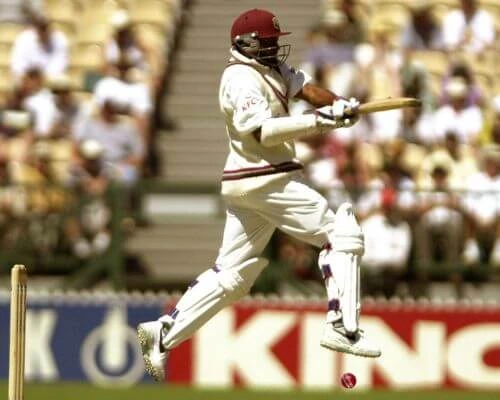
Who Is Brian Lara?
Brian Charles Lara was born on May 2, 1969, in Santa Cruz, Trinidad. He is a West Indian cricketer widely regarded as one of the greatest batters the game has ever produced. A left-handed batter with a high backlift and a style that blended elegance with aggression, Lara played international cricket from 1990 to 2007.
He represented the West Indies at a time when the team was going through a difficult transition – the era of dominant West Indian cricket that terrorized the world in the 1970s and 80s was fading, and Lara became the man expected to carry an entire batting lineup almost single-handedly.
He stood at roughly 5’8″, held his bat with a grip that produced one of the most distinctive and beautiful cover drives in cricket history, and had a temperament that somehow combined relaxed strokeplay with fierce competitive instinct.
He retired from international cricket in 2007 but has never truly left the game’s consciousness.
Why Is Brian Lara So Famous?
People who did not grow up watching cricket still know his name. That alone tells you something.
He is famous for several reasons that go far beyond statistics. Yes, the numbers are staggering – but numbers alone do not make a cricketer legendary. What made Lara different was the manner in which he played and the context in which he produced his greatest innings.
He played for a West Indian side that was in decline. There was no dominant pace attack behind him, no deep batting lineup to share the load. When Lara walked in, it frequently felt like the entire team’s fortunes rested on one man. And time after time, across formats and conditions, he delivered.
His 400 not out against England in 2004 remains the highest individual score in the history of Test cricket. His 501 not out for Warwickshire against Durham in 1994 remains the highest score in first-class cricket anywhere in the world. Both records belong to the same man. That simply does not happen in sport – one athlete holding the absolute summit in two different categories of the same game.
Beyond records, Lara was beautiful to watch. His footwork was instinctive, his timing was almost musical, and his ability to build an innings – to go from 50 to 100 to 200 to 300 without ever appearing to force anything- was unlike anything most fans had seen before or since.
He also had a flair for the dramatic. His innings were not just long; they were meaningful. He saved Tests. He chased down impossible totals. He made cricket feel like theatre.
That combination – records, responsibility, and artistry – is why Lara is still so famous.
Lara’s Highest Score in Test Cricket
The 400 Not Out Innings
On April 10, 2004, at Antigua Recreation Ground in St. John’s, Antigua, Brian Lara walked off the field having scored 400 not out against England. It was not just a personal milestone. It was the highest individual score in the entire history of Test cricket.
This was actually the second time Lara had held that record. He had previously scored 375 against England in 1994, a record that was broken by Matthew Hayden, who scored 380 in 2003. Lara then reclaimed it in 2004, a detail that adds an almost cinematic quality to the story.
The innings lasted 778 minutes. He faced 582 balls. He hit 43 fours and 4 sixes. England’s bowling attack was dismantled ball by ball, session by session, across nearly two full days of batting.
What made it remarkable beyond the sheer volume of runs was the control. Lara never appeared to be grinding. Even at 300, even at 350, his strokeplay remained fluent. The innings had rhythm. It had personality. It felt like it belonged to him.
Why the 400 Innings Still Matter
Two decades later, the 400 not out still stands unchallenged. In an era of T20 cricket where batters play hundreds of international innings, nobody has come close to matching it in the Test format.
The reason it still resonates is not just the number. It is the weight of what the innings represented — a player reclaiming a record he had lost, doing so with artistry and patience, and doing it for a West Indian team that desperately needed something to celebrate.
Younger fans who search for Brian Lara 400 today are not just looking up a stat. They are trying to understand what the fuss is about. When they watch the footage, they usually understand immediately.
Highest Scorer in Test Scorecard
For those looking for the clean scorecard summary:
- Score: 400 not out
- Opponent: England
- Venue: Antigua Recreation Ground, Antigua
- Year: 2004
- Balls faced: 582
- Duration: 778 minutes
- Fours: 43
- Sixes: 4
- Match result: Draw
501 Not Out : The First-Class Record
If the 400 in Tests is extraordinary, the 501 not out is almost beyond comprehension.
In June 1994, playing for Warwickshire against Durham in the English County Championship, Brian Lara scored 501 not out – the highest individual score in the history of first-class cricket. He was 25 years old.
First-class cricket sits below Test cricket in terms of prestige, but it is the same long format – red ball, timed matches, proper bowling attacks. A score of 501 in any professional cricket context is not a number that should be possible for one person in one innings.
To put it in context: the previous first-class record was 501 itself, no, that is not a typo. The previous record was 499 by Hanif Mohammad in 1959. Lara passed it and kept going.
He batted for 474 minutes, faced 427 balls, hit 72 fours and 10 sixes. Warwickshire declared when Lara was dismissed, or rather, when Lara chose to end the innings, depending on your reading of events.
The 501 not out adds something important to Brian Lara’s legacy: it shows that the 400 in Tests was not a fluke of conditions or a weak attack. Across different formats, different countries, and different competitions, this man simply batted at a level nobody else has reached.
Lara’s Highest Score in ODI Cricket
Brian Lara’s highest score in ODI cricket was 169 against Sri Lanka in 1999, during the Cricket World Cup. It remains one of the finest individual ODI innings West Indies have ever produced.
Lara’s ODI career is often discussed in the shadow of his Test brilliance, but that somewhat undersells what he contributed to the format. He averaged around 40 in ODIs, which across his era was a strong mark for a top-order batter.
Where he differed from his Test persona was the tempo. In Tests, Lara could build across days. In ODIs, he adapted — shortening his backswing when needed, accelerating at key moments, and using his natural timing to clear the boundary without needing brute strength.
His ODI impact was not as historically dominant as his Test record, but for West Indies fans watching a team that was often struggling, a Lara ODI innings remained an event.
Did Brian Lara Have a Highest Score in T20?
T20 cricket was in its absolute infancy when Brian Lara retired in 2007. The Indian Premier League launched in 2008 – one year after he played his last international match. The ICC World Twenty20 had only begun in 2007.
Lara did play some T20 cricket late in his career, but it was never the format associated with his legacy. His highest T20 score was modest – this was simply not the era in which T20 was a primary career format for established Test cricketers.
This is worth saying clearly: Lara’s fame has nothing to do with T20 cricket. His legacy was built entirely in the red-ball game, with significant ODI contributions alongside it. Measuring him against T20 standards misses the point of what he was.
Brian Lara Stats: Test, ODI and Overall Career Numbers
The following table summarizes Lara’s batting performance across major formats, synthesized from his international career and domestic stints with teams like Trinidad and Tobago and Warwickshire.
| Statistic | Test | ODI | First-Class (FC) | List A (LA) |
|---|---|---|---|---|
| Matches | 131 | 299 | 261 | 429 |
| Innings | 232 | 289 | — | — |
| Runs Scored | 11,953 | 10,405 | 22,156 | 14,602 |
| Batting Average | 52.88 | 40.48 | 51.88 | 39.67 |
| Top Score | 400* | 169 | 501* | 169 |
| Balls Faced | 19,753 | 13,086 | — | — |
| Strike Rate | 60.52 | 79.52 | — | — |
| 100s (Centuries) | 34 | 19 | 65 | 27 |
| 50s (Half-Centuries) | 48 | 63 | 88 | 86 |
| 200s (Double 100s) | 9 | 0 | — | — |
| 300s (Triple 100s) | 2 | 0 | — | — |
| 400s (Quadruple 100s) | 1 | 0 | 2 | — |
| Fours / Sixes | 1,559 / 88 | 1,035 / 133 | — | — |
| Ducks | 17 | 16 | — | — |
| Not Outs | 6 | 30 | — | — |
| Catches | 164 | 120 | 320 | 177 |
——————————————————————————–
Career Bowling Statistics
While primarily a batsman, Lara occasionally bowled leg-break.
| Statistic | Test | ODI | FC | LA |
|---|---|---|---|---|
| Wickets | 0 | 4 | 4 | 5 |
| Bowling Average | — | 15.25 | 104.00 | 29.80 |
| Economy Rate | 2.80 | 7.47 | — | — |
| Best Bowling | — | 2/5 | 1/1 | 2/5 |
| Balls Bowled | 60 | 49 | 514 | 130 |
——————————————————————————–
Career Timeline & Milestones
- Test Debut: 6 December 1990 v Pakistan (scored 44 & 5).
- Last Test: 27 November 2006 v Pakistan.
- ODI Debut: 9 November 1990 v Pakistan (scored 11).
- Last ODI: 21 April 2007 v England.
- World Record (Test): Highest individual score of 400 not out against England in 2004.
- World Record (First-Class): Highest individual score of 501 not out for Warwickshire against Durham in 1994.
- Captaincy Success: Led West Indies to victory in the 2004 ICC Champions Trophy.
- Hall of Fame: Inducted into the ICC Hall of Fame in September 2012
Brian Lara Overall Legacy in Numbers
Lara sits comfortably among the all-time leading run-scorers in both Test and ODI cricket. His Test average of 52.88 across 131 matches – for a West Indian team that was often outgunned- carries more weight than the raw number suggests.
His 34 Test centuries are a record of consistency that often gets overlooked in conversations about his genius. Lara was not only capable of the unreachable innings, he was also a regular, reliable producer of match-winning knocks.
What Made Brian Lara Different as a Batter?
Plenty of cricketers have scored more runs than Brian Lara in aggregate. The T20 era has produced batters with extraordinary strike rates and batters with enormous career volumes. But when you ask serious cricket observers where Lara sits among the all-time greats, the answer is almost always near the very top.
Why?
It starts with his stance and backlift. Lara’s high backlift was a risk; it gave bowlers a longer window to find the edge. But it also generated extraordinary power through timing alone. He did not muscle the ball; he met it at the perfect moment with perfect placement.
His footwork against spin was exceptional. His ability to get forward or back decisively, to use his feet to create angles, separated him from contemporaries who relied on reach alone.
There was also a mental quality that is harder to quantify. Lara batted longest and best when the situation demanded it most. His most famous innings were not compiled in dead rubbers or against weak attacks – they came under pressure, often when West Indies were in trouble, often when the match was in the balance.
And then there was the style. Cricket has produced efficient batters, reliable batters, and destructive batters. Very few have been genuinely beautiful to watch in the way Lara was. His cover drive, his pull shot, his late cut — each stroke had a quality that made spectators pause.
Brian Lara’s Most Famous Records
- Highest individual score in Test cricket: 400 not out vs England, 2004
- Highest individual score in first-class cricket: 501 not out for Warwickshire vs Durham, 1994
- First player to score 375 in Test cricket: vs England, 1994 (later surpassed and then reclaimed)
- Only player to hold the Test and first-class world record simultaneously
- 11,953 Test runs – among the highest tallies in history
- 34 Test centuries – reflecting both consistency and peak genius
No other batter in history has held the absolute record in both Test and first-class cricket at any point in their career. That distinction belongs solely to Lara.
Brian Lara Cricket Academy and Life Beyond Playing
After retiring, Lara has remained connected to the sport through the Brian Lara Cricket Academy in Trinidad – a facility that carries his name and reflects his commitment to developing cricket in the Caribbean.
The Academy represents something meaningful: Lara’s recognition that West Indian cricket needs infrastructure, coaching pathways, and a place where young talent can develop properly. His involvement in grassroots development has added a quieter but important chapter to his post-playing legacy.
He has also worked in cricket commentary and various ambassadorial roles, remaining a recognisable and respected voice in the sport.
How Rich Is Brian Lara?
Various sources estimate Brian Lara’s net worth somewhere between $60 million and $100 million, though these figures vary widely and should be treated as estimates rather than verified figures.
What is clear is that his wealth comes from multiple streams: his professional cricket career spanning nearly two decades, endorsement deals during his playing days, commentary work, and ongoing commercial and ambassadorial engagements tied to his status as one of cricket’s greatest names.
Lara was also one of the earlier cricketers to benefit from the growing commercial value of international cricket in the 1990s and 2000s. His fame in the Caribbean, the UK, India, and across the cricket world made him a valuable commercial property during his peak years.
The honest answer is that precise net worth figures for most retired cricketers are not publicly confirmed. What is not in dispute is that Brian Lara built a career and a reputation that has continued to generate value long after he stopped playing.
Brian Lara Age, Personal Profile and Quick Facts
| Detail | Information |
|---|---|
| Full Name | Brian Charles Lara |
| Date of Birth | May 2, 1969 |
| Nationality | Trinidadian / West Indian |
| Batting Style | Left-handed |
| Role | Top-order batter |
| Major Teams | West Indies, Trinidad, Warwickshire |
| International Career | 1990 – 2007 |
| Test Highest Score | 400 not out |
| First-Class Highest Score | 501 not out |
Why Brian Lara Still Matters in Cricket History
Sport has short memory by nature. Players retire, records get broken, new heroes emerge. But certain names persist, not because they are protected by nostalgia, but because what they did genuinely cannot be replicated or easily explained.
Brian Lara is one of those names.
Younger fans who were not alive to watch him play still search his name, still watch his innings on YouTube, still debate where he sits among the all-time greats. That kind of sustained interest does not happen by accident. It happens because the work itself was extraordinary.
His records have outlasted his retirement by nearly two decades. His style remains a reference point for how batting can look when technique and instinct are perfectly aligned. His innings against England in 2004, his 501 in county cricket, his match-saving knocks for West Indies in Tests across the 1990s, these are part of cricket’s permanent record.
He also matters as a symbol of what one player can do for a team in decline. West Indies cricket went through painful years during and after Lara’s career. He could not reverse the structural problems on his own, but he gave fans something to hold onto, the knowledge that even in difficult times, the best player on the pitch was one of the best players who had ever lived.
Frequently Asked Questions
Why is Lara so famous? Brian Lara is famous for holding the highest individual scores in both Test cricket and first-class cricket, for his extraordinary strokeplay, and for carrying West Indies cricket almost single-handedly during a difficult period in the team’s history.
What is Brian Lara’s highest score in Test cricket? 400 not out, scored against England at Antigua in 2004. It remains the highest individual score in Test cricket history.
What is Brian Lara’s highest ODI score? 169, scored against Sri Lanka during the 1999 Cricket World Cup.
What is Brian Lara’s 501 not out? His score for Warwickshire against Durham in the English County Championship in 1994 – the highest individual score in the history of first-class cricket.
What are Brian Lara’s career stats? In Tests: 11,953 runs at an average of 52.88, with 34 centuries. In ODIs: 10,405 runs at 40.48, with 19 centuries.
Did Brian Lara play T20 cricket? He played very little T20 cricket. T20 emerged at the very end of his career and was never the format associated with his legacy.
What is Brian Lara Cricket Academy? A cricket development facility in Trinidad that carries his name and supports the growth of cricket in the Caribbean.
How rich is Brian Lara? Estimates vary, but public sources suggest a net worth in the range of $60 to $100 million, built through his playing career, endorsements, and post-retirement work.
Why is Brian Lara still considered one of cricket’s greats? Because his records remain unbroken, his innings remain compelling viewing decades later, and no other batter has matched his combination of volume, peak performance, and artistry.
Final Thoughts on Brian Lara
Some players are remembered for their numbers. Some are remembered for their style. Brian Lara is one of the rare few remembered for both, and remembered deeply, not just as a footnote in record books.
The 400 not out and the 501 not out are not just statistics. They are statements about what is possible when talent, preparation, and a competitive will to be the best collide at exactly the right moment.
Cricket has produced great run-scorers before Lara and will produce great run-scorers after him. But there is something specific about what Lara did, the way he looked doing it, the circumstances he did it in, and the records he left behind – that places him in a category of his own.
He did not just play cricket. He elevated it.